
Why does "doing nothing" feel so scary?
An empty calendar feels like a threat and a quiet room feels like a trap.

In Partnership With Fodex official
Your payment account could be earning money

Fodex Agency works with multiple online brands and has processed more than $20M in sales.
Instead of running a store yourself, their team handles the entire operation:
Products
Ads
Fulfillment
Customer support
Taxes
Partners simply allow processing volume and earn a percentage of sales in return. Some report earnings up to $4,000 per day depending on capacity.
No login access required, and you can stop anytime
You aren't "productive." You are dysregulated. You aren't "ambitious." You are braced. And it is quietly killing the version of you that was actually meant to enjoy being alive.
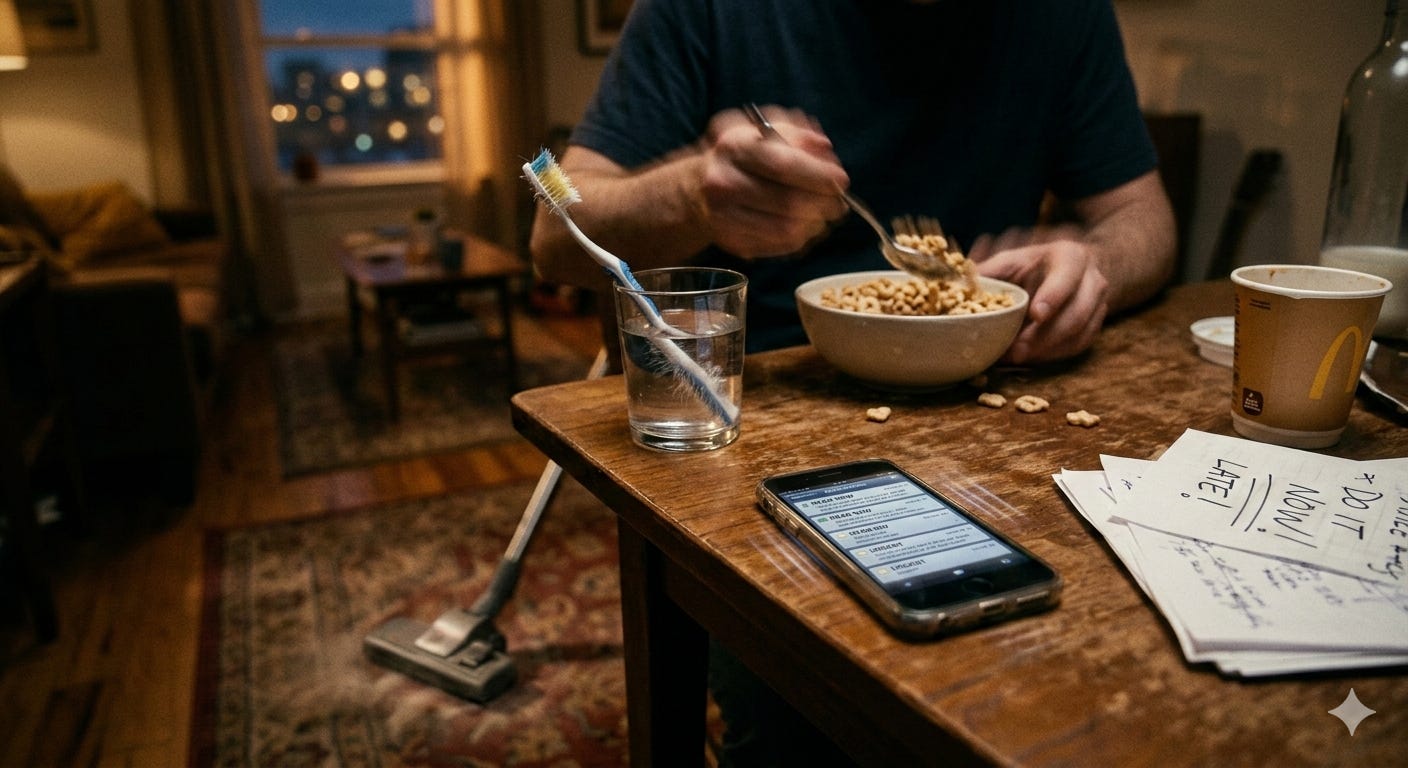
We have entered a collective trance where “urgency” is no longer a response to a crisis; it is our permanent personality. We have become a generation of people who brush our teeth like we’re running late for a funeral. We attack the living room with a vacuum cleaner like it’s an Olympic sport. We clench our muscles to type routine emails, replying instantly not because the world will end, but because a “1” on an app icon feels like a ticking time bomb we are desperate to defuse.
We inhale our food as if someone might snatch the plate away. We consume podcasts at 2x speed because a human voice speaking at a natural, melodic pace now feels “unbearably slow.” We stride down sidewalks with a face of grim determination, even when we have nowhere to be and all the time in the world to get there.
Everything—absolutely everything—must be done now.
But here is the haunting, terrifying truth: There is no bear. There is no immediate threat. There is no actual catastrophe unfolding. Yet, your body is braced for impact, navigating a “normal” Wednesday as if you are traversing a minefield.
You aren’t “productive.” You are dysregulated. You aren’t “ambitious.” You are braced. And it is quietly killing the version of you that was actually meant to enjoy being alive.
We weren’t designed to live like this. To escape the trance, you first have to understand exactly how you were tricked into the race.
The Murder of the Natural Rhythm
For the vast majority of human existence, life had a built-in “pause” button. It wasn’t a lifestyle choice; it was a physical law. When the sun went down, the day ended. Whether you were in the middle of a project, a conversation, or a chore, the darkness was an immovable wall. You stopped because you literally could not see what you were doing.
There was a rhythm to the seasons that was impossible to argue with. Winter meant slowing down, huddling, and conserving energy. Summer meant expansion and light. Our bodies were in sync with the environment. If you wanted to talk to someone, you walked to find them. The journey took what it took. If you were cooking over a fire, you waited. These natural pauses—the waiting, the quiet, the stopping—were baked into the human experience. We had permission to move at a human pace because there was no other option.
Then, we “fixed” it.
We harnessed electricity and murdered the night. We built assembly lines where speed became the only metric of human value. We invented the smartphone—the most effective digital leash in history—ensuring the entire world could scream for our attention while we’re in the shower, at dinner, or trying to sleep. We created microwaves, dishwashers, and high-speed fiber optics, all promising to “save us time.”
But the time never came. Instead of using that “saved” time to rest, we simply raised the bar of what we expected from ourselves. Because we can do things faster, we decided we must. We systematically removed every buffer. Now, when the day ends, it doesn’t matter. You just flip a switch and keep grinding. We adapted to a pace no human was ever meant to sustain—a pace that is relentless, always on, and always performing.
The Biology of “Survival Mode”
Your nervous system is a masterpiece of evolution, but it hasn’t had a hardware update in 50,000 years. It is designed to handle short, intense bursts of stress. You see a predator; your heart rate spikes; blood rushes to your limbs; your digestive and immune systems shut down so all energy can go toward “not dying.” Once the threat is gone, you return to a calm baseline to recover.
But in the modern world, the “threat” never leaves.
The “threat” is the 53 unread messages. The “threat” is the fear of being “out-hustled.” The “threat” is the social media feed showing you everyone else’s curated success. Because these threats are constant, we never exit the “fight or flight” stage. We are marinating in cortisol.
When you live in this state, you aren’t more effective—you are dysregulated. You shift into survival mode. Survival mode is great for escaping a car accident, but it is catastrophic for a creative, fulfilling life. In survival mode, you aren’t thoughtful; you’re reactive. You aren’t focused; you’re hyper-vigilant, scanning for problems that don’t exist.
This is the real reason we procrastinate on our biggest dreams. Your nervous system doesn’t care about your book project or your scaling business when it thinks it’s fighting for its life. To a body in survival mode, “creativity” is a luxury it can’t afford. This is why you scroll mindlessly instead of doing the work. You aren’t lazy. You are biologically overwhelmed.
The Dark Addiction: Why Peace Feels “Wrong”
Here is the most uncomfortable truth: After living in the “Invisible Emergency” for long enough, your body starts to crave the chaos.
The human brain prefers what is familiar over what is healthy. If you have been stressed for five years, “peace” feels suspicious. A quiet, unscheduled Sunday feels like a trap. You feel like you “should” be doing something—anything—to bring back that familiar hum of anxiety.
We talk about addiction to substances, but we are just as addicted to emotional states. We can become addicted to the feeling of being “busy” because it makes us feel important. We can be addicted to the “guilt” of not doing enough because it’s a weight we’ve learned to carry. We use caffeine to stay “wired” and true-crime podcasts to stay “on edge,” reinforcing a baseline of unsettledness.
We are keeping the engine running at redline while the car is in park. We have become active participants in our own urgency, keeping the fire burning because the coldness of a quiet room is too terrifying to face.
The “How-To” of Slowing Down
Stepping out of this pattern doesn’t require a 10-day retreat or a new productivity app. It starts with The Gap.
The first step is simply noticing. Notice the next time you’re rushing for no reason. Notice when you’re gripping the steering wheel like you’re in a Formula 1 race just to go to the grocery store. Don’t judge it. Just see it. In that moment of seeing, you create a tiny gap between the impulse and the action.
In that gap, you have a choice. You can consciously relax your jaw. You can take a breath that actually reaches your belly. You can ask yourself a different question.
Instead of asking, “How fast can I get this done?” ask, “How good can I let this feel?”
How much ease can you bring to washing the dishes? How much fun can you have while folding laundry? How much play can you bring to that “difficult” business task? Most of your life is made up of these tiny, mundane moments. If you bring tension to all of them, you aren’t living; you’re just enduring a very long, very fast race to the grave.
The Choice is Yours
You cannot control the speed of the global economy. You cannot stop the emails from coming. But you have absolute, 100% sovereignty over the level of urgency you hold in your own cells. You can choose to meet the world from a place of regulation instead of panic.
It will feel strange at first. Your body will scream at you to “do more.” Familiarity is a powerful pull. But familiar doesn’t mean “right.”
You were never meant to be a high-output machine. You were meant to be a human being—rhythmic, seasonal, and occasionally, wonderfully still. The “emergency” is a lie. The “rush” is a ghost.
Excellent description of survival mode and how it undoes us.