
How to *Actually* Become SECURELY ATTACHED
Why Your "Boundaries" are Actually Just Cowardice

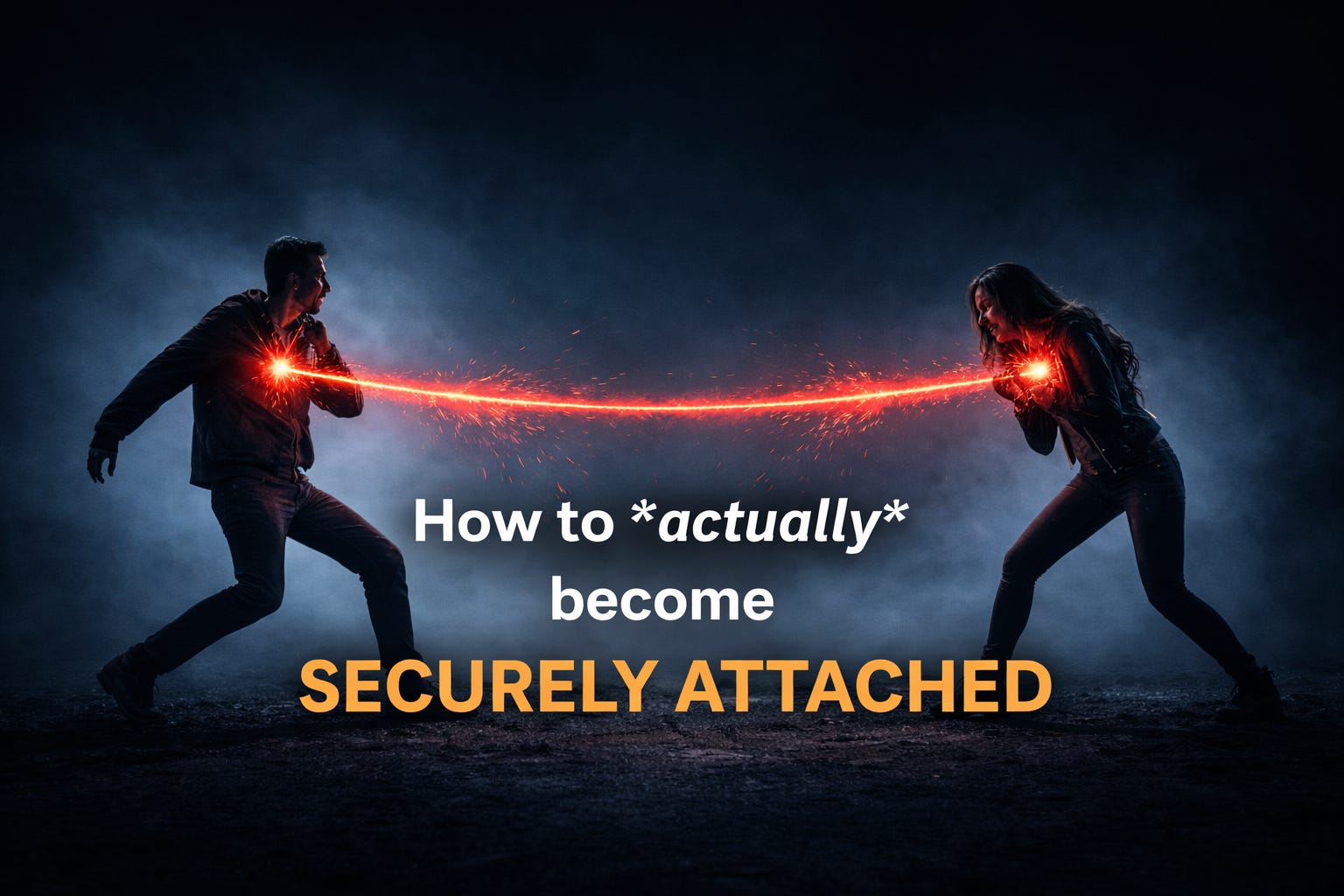
If you are currently staring at your phone, vibrating with the urge to send a triple-paragraph text because they haven’t replied in four hours—stop.
If you are constantly analyzing the “vibe” of a room, wondering if they still like you, or trying to act “low-maintenance” while your internal organs are literally doing backflips from stress—read this carefully.
That feeling? That electric, heart-pounding, gut-wrenching intensity? That is not love. It’s not “passion.” It’s not “destiny.”
It is anxiety. It is a survival response. It is fear wearing a romantic costume.
And on the flip side, if you find yourself pulling away the second someone gets too close—if you suddenly get the “ick” because they were “too nice,” or if you keep one foot out the door because “independence is everything”—that isn’t love either. That’s avoidance. That’s your nervous system building a bunker and calling it a personality.
It is the same trauma, just a different font.
Most of us are exhausted. We are trapped on a psychological merry-go-round that won’t stop spinning. One day, you’re the hunter, chasing someone who treats intimacy like a plague. The next, you’re the prey, sprinting away from someone who actually wants to know you. You’re either doing too much or not enough. You’re either “too much” or “not there at all.”
But here is the chilling truth that self-help books won’t tell you: Both strategies are your brain trying to solve the same terrifying problem. You are trying to find safety in a territory where “safe” has never existed.
In this deep dive, we are going to strip back the mask. We are going to identify the specific flavor of psychological warfare you’re waging on yourself. Most importantly, I’m going to show you the exact framework to exit the anxious-avoidant roller coaster forever. We are moving toward a level of bulletproof confidence that most people will never experience.
The Great “Detachment” Deception: Why You’re Doing It Wrong
Before we fix the pattern, we have to fix the language. “Detachment” is the buzzword of the century. It’s tossed around like confetti, but almost everyone is using it as a weapon rather than a tool.
If you’re avoidant, you hear “detach” and you think: Perfect. I’ll just ghost everyone, stop answering calls, and call it “protecting my peace.”
Newsflash: That’s not detachment. That’s cowardice.
If you’re anxious, you hear “detach” and you immediately start to hyperventilate. You think: Detach? You mean stop caring? You mean I have to be alone forever while they forget I exist?
Newsflash: That’s not what we’re doing here.
Real, healthy detachment isn’t being a cold-blooded robot.
It is the radical, thrilling ability to care about someone without making their shifting moods your full-time job. It is loving someone without losing your own DNA in the process. It is wanting things to work out, but being so grounded in your own worth that you don’t feel the need to micromanage the universe to make sure they do.
Healthy detachment and secure attachment are “besties.” They are the same thing.
If you’ve been ping-ponging between “I’m too much” and “I don’t need anyone,” you aren’t broken. You are just stuck in survival mode. Your nervous system is trying to keep you alive using outdated software from 1998. It’s time for an upgrade.
The Four “Default Settings” of Your Heart
Attachment styles aren’t your destiny; they are just your nervous system’s “factory settings.” But guess what? Settings can be reconfigured.
Let’s look into the mirror and see which one is staring back at you.
1. Anxious Attachment: The Chaser
To you, connection feels like oxygen—but you’re always afraid someone is standing on the hose. You crave closeness, but you’re terrified of abandonment.
In the real world, this looks like refreshing Instagram to see if they’ve watched your story. It looks like analyzing the “tone” of a text message for three hours. When someone pulls back even a millimeter, your brain goes into Code Red. You over-explain. You apologize for things you didn’t do. You feel like you have to “earn” love, and you’re terrified that if you stop “performing,” they’ll realize you aren’t worth the trouble.
2. Avoidant Attachment: The Runner
Independence feels like safety, but intimacy feels like a cage. You want connection, but only on your terms—and preferably from a safe distance.
You’re the person who gets the “ick” over a tiny, irrational detail. You keep your options open “just in case.” When a partner wants a serious emotional conversation, your first instinct is to find the nearest exit. You pride yourself on being “low-maintenance,” but really, you’ve just convinced yourself that needing people is a fatal weakness.
